What people actually paid
Recorded sale prices from Washington State vehicle title records — not asking prices.
Too few sales at a comparable odometer reading to price this car against, so these figures cover the model at any mileage — compare them to the 27,508 mi median above rather than reading them as this car's market value.
Based on 522 sales of this model year, any mileage, over the last 2 years. Washington is the only state that publishes what buyers actually paid, so these are Washington sales — a national reference point, not local pricing. Sales under $5,000 are excluded because the state's figure is a declared price and the low end includes family transfers. Source: Washington State Department of Licensing (ODbL).
This exact version — researched
DC fast charging was a $750 option (RPO CBT) on both trims through MY2020, and it is not retrofittable at sensible cost. Check any straight-on charge-port photo: CCS cars show two large DC pins behind a hinged flap below the J1772 ring; non-CCS cars show a plain blank oval. Corroborate with the RPO sticker in the glovebox (code CBT).
How we know this — and what it means for you
Every Bolt can charge at home or at public Level 2 stations. But the ability to use DC fast chargers — the road-trip kind — was a $750 factory option through 2020, and many buyers skipped it. If the first owner didn’t order it, the car physically lacks the hardware, and adding it later means new port wiring and contactors, not a software unlock: effectively, it’s permanent. How to tell: look at the charge-port photo in any listing. Fast-charge cars show two large pins behind a small flap below the round connector; cars without it show a smooth blank oval. The order code (CBT) also appears on the sticker inside the glovebox. Dealers frequently don’t know this about their own inventory, which is exactly why we check the photo.
Under recall 21V560, 2017–2019 cars mostly received new modules with the later chemistry (~+8% capacity; the EPA label was never re-rated). Ask for campaign history from GM's owner centre and look for GM program N212343880/N212343881 (new modules/pack) vs N212343883 (software only). "21V560 complete" alone is meaningless. A battery-warranty mileage cap above 100,000 is an independent fingerprint of a replaced pack.
GM's Bolt-era booklet sets no percentage trigger at all; it says the battery “may degrade as little as 10% to as much as 40% of capacity over the warranty period” and covers defects, not degradation. One upside, also verified: batteries replaced under the recall got a fresh 8-year/100k parts warranty from the replacement date (GM bulletin 22-NA-119).
Battery & range
Thermal
Charging
Warranty, for the next owner
The dealer's description
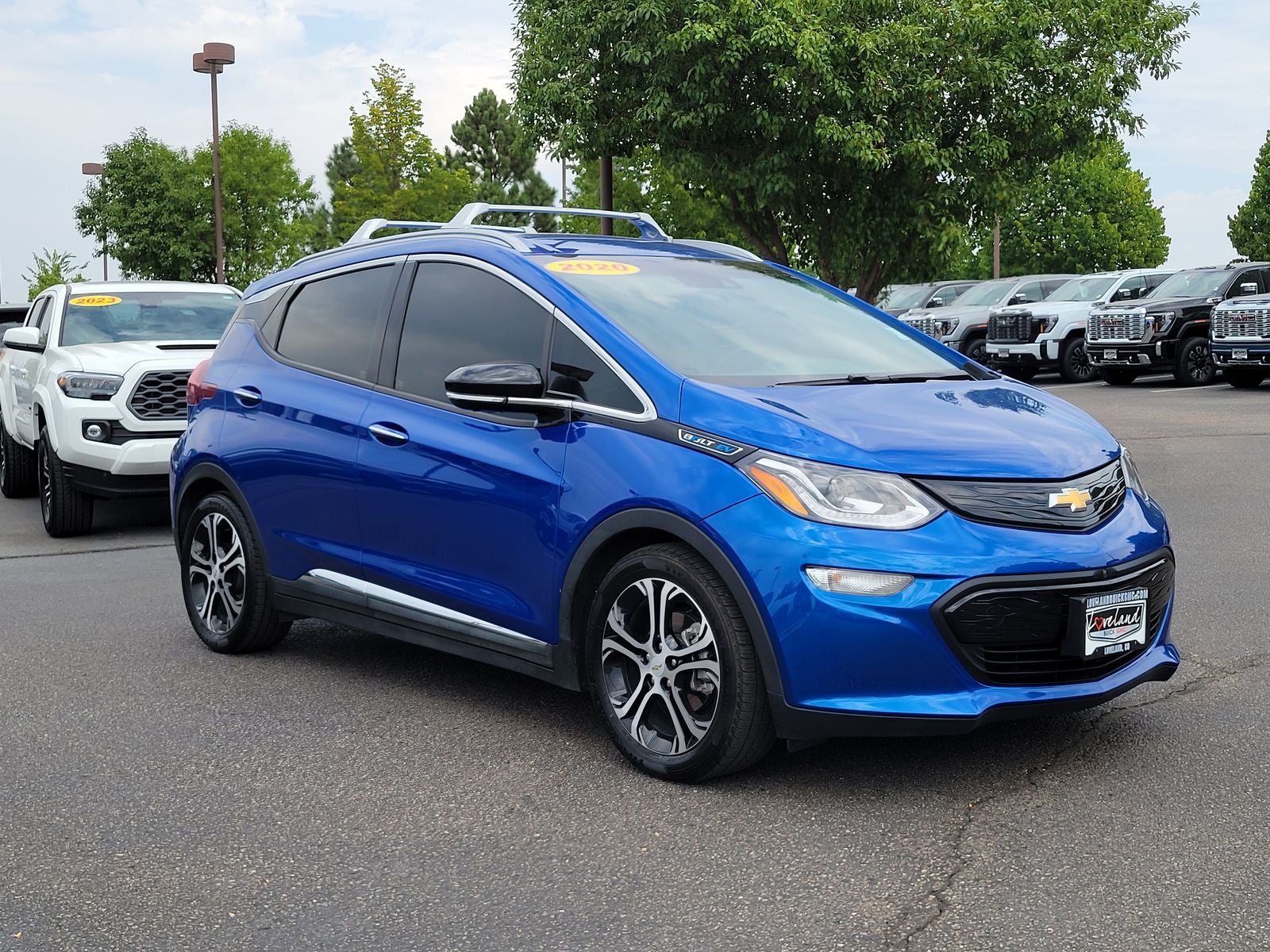
Kinetic Blue Metallic 2020 Chevrolet Bolt EV Premier FWD 1-Speed Automatic Electric Drive Unit Recent Arrival! Odometer is 18754 miles below market average! 127/108 City/Highway MPG
Worth asking the seller (3)
- GM campaign history for this VIN — which 21V560 program number? — N212343880/81 = new modules or pack, N212343883 = software only. Free at GM's owner centre; "recall complete" alone doesn't say which.
- Battery health report — The seller can pull one from the car — it's the only real degradation data; nothing remote can measure it.
- Build date (door-jamb sticker) and original in-service date — Settles mid-year running changes; the in-service date, not the model year, starts the warranty clock.
2020 Chevrolet Bolt EV
Premier